How technology is shaping the future of sustainable construction

First published in the December 2025 issue of Quarry Management as Concrete Evolution
By Craig Godsman, product manager – ready-mix concrete and concrete products, Breedon GB
Concrete remains the cornerstone of the construction industry, and with the Government setting its sights on delivering 1.5 million new homes – as well as major infrastructure projects – it has arguably never been more vital. However, despite policy ambitions signalling the need to build, the sale of ready-mixed concrete has fallen by 11.5%, reaching its lowest level in more than six decades. For producers, the challenges have rarely been sharper: a sector caught between fluctuating demand, volatile production costs, and an ever-tightening focus on sustainability.
Producers have a fine line to walk, striving to make concrete more sustainable without pricing it out of viability. The good news is that technology is increasingly helping to bridge that gap; driving down emissions, optimizing production, and improving performance in ways that support both commercial and environmental goals.
How concrete has evolved
Concrete technology has undergone a remarkable transformation since the 1960s, evolving into a science-driven, performance-based process. In the past, workability and strength were primarily controlled by adjusting the water-cement ratio – often at the expense of durability. The introduction of chemical admixtures – first lignosulfonate-based plasticisers, followed by high-range superplasticisers and modern polycarboxylate ethers – revolutionized concrete performance, enabling higher strengths, reduced water content, and the development of self-compacting concrete.
At the same time, cement chemistry diversified beyond Ordinary Portland Cement (OPC). The widespread use of supplementary cementitious materials such as fly-ash, ground granulated blast-furnace slag (ggbs), and silica fume improved durability, reduced permeability, and significantly lowered the carbon footprint of construction. Today, clients are looking for lower-carbon solutions allowing the use of secondary cementitious materials such as PFA (pulverized fuel ash) and ggbs as a mainstay. Other products such as limestone cements, calcined-clays, and alkali-activated materials also help cement manufacturers to meet ambitious sustainability goals.
Contemporary mix design is now guided by laboratory testing and life-cycle assessment, balancing strength, workability, and environmental performance. These innovations have produced concretes that are more durable and more sustainable than ever before. The shift marks a fundamental change in construction materials science – one that aligns perfectly with the global drive towards greener, longer-lasting infrastructure.
Designing mixes fit for modern construction
For concrete, there are infinite combinations, with each carefully tailored to meet the unique performance, environmental, and logistical requirements of a project. Concrete mix design has become an exercise in balance, with an intricate interplay between strength, workability, cost, and sustainability. A coastal defence structure, for instance, demands entirely different durability thresholds to a residential foundation or precast façade panel.
For quarry and materials providers, this complexity means every component – aggregates, cementitious materials, admixtures, and even delivery timing – must align precisely to meet both technical and environmental specifications. The carbon intensity of a mix is now a board-level concern, influencing procurement decisions and reputation alike.
In the past, achieving performance often meant compromise. Rapid-setting concrete, for example, typically required a lower proportion of ground granulated blast-furnace slag to accelerate early strength gain, a trade-off that increased embodied carbon. Today, however, new admixture technology has changed that equation. Lower-carbon strength enhancers now allow contractors to maintain high early strength and similar setting times while retaining a greater ggbs content, significantly reducing emissions.
Admixture innovation has also expanded on-site flexibility. Placement enhancers extend workability, giving contractors more time to pour and finish complex or heavily reinforced structures without compromising performance. Specialist mixes have emerged for demanding environments too, from underwater concrete with anti-washout properties – such as Breedon Nautilus – to ultra-durable formulations, like Breedon Titan, for marine and industrial applications.
These examples highlight how far concrete technology has come. By combining data, laboratory testing, and chemistry, producers can now fine-tune every element of a mix to deliver the precise balance a project demands. Optimization is now as important as specification, and this shift is redefining what is possible in sustainable construction.

Sustainability beyond carbon
For the construction industry to achieve its decarbonization goals, concrete must play its part. Quarry operators and ready-mixed concrete producers are already embedding lower-carbon processes, including everything from alternative fuels and clinker substitution to energy-efficient batching plants. But it is important to recognize that sustainability extends beyond the immediate carbon footprint.
A longer-lasting, more durable structure reduces lifecycle emissions by spreading embodied carbon over decades of use. Recycled aggregates and industrial by-products help create a circular economy and reduce pressure on primary extraction. Meanwhile, water efficiency, responsible sourcing, and biodiversity management are fast becoming standard expectations within the industry, rather than unique selling points.
Achieving true sustainability, therefore, is multidimensional: taking into account environmental, economic, and social considerations. Providers should be focused on materials that perform well, cost less to maintain, and come from supply chains that communities trust.
Innovation driving sustainable concrete
Several technologies are redefining how concrete is produced and specified across the UK:
Geopolymer and lower-carbon binders: By replacing a large portion of cement with alternative materials, these mixes can cut CO2 emissions by up to 80%.
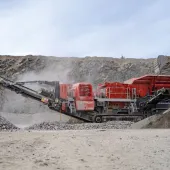
Mix optimization: Before the development of advanced admixture technology, concrete production relied heavily on natural sand and gravel. Today, thanks to modern admixtures, producers can incorporate alternative materials that were once considered unsuitable for ready-mixed concrete, such as aggregates with high clay contents. This innovation offers significant sustainability benefits, with admixture technology enabling the use of locally available hard rock aggregates and crushed rock fines (CRF) from nearby quarries, reducing transportation distances and lowering emissions.
Carbon capture at source: This allows carbon to be captured directly from industrial sources during the cement-making process – for example, in cement kilns, preventing the carbon from entering the atmosphere. This carbon is then either stored underground or used in other industrial activities. Breedon are part of the Peak Cluster project, the world’s largest cement decarbonization project.
Carbon capture in the manufacturing process: New technologies also exist to capture carbon in other stages of the manufacturing process too. For example, Breedon are partnering with CarbonCure to inject captured CO2 into the concrete mixing process.
Breedon are working hard to provide all of these more innovative solutions, which ensure that sustainability is at the core of construction. The company also believes that sustainability does not end at the mixer, and is one of many quarry operators embracing biodiversity, with a focus on restoring sites and creating habitats as part of a responsible-sourcing approach.

Partnering for performance and sustainability
Early collaboration between suppliers, designers, and contractors is now fundamental. Defining the right mix, supply chain, and sustainability metrics from the outset saves on both carbon and cost later in the project. Suppliers who can deliver robust data responding to these criteria are better placed to help clients make informed and responsible decisions.
For the Breedon Performance Concretes range, for example, collaboration has been essential, and the company’s teams always enjoy working with customers from specification through to delivery to produce a more durable but cost-efficient solution.
Looking ahead
The future of concrete is ever evolving, and whilst the economic uncertainty may have dampened demand, it is clear that innovation has never been stronger. New materials and circular economy models are all reshaping what is in the realms of the possible. The sector’s task is to harness these technologies at scale, ensuring that every cubic metre of concrete contributes to ensuring both a robust built environment and a resilient planet.
Subscribe to Quarry Management, the monthly journal for the mineral products industry, to read articles before they appear on Agg-Net.com