Nurock Mixers ‘on the right track’
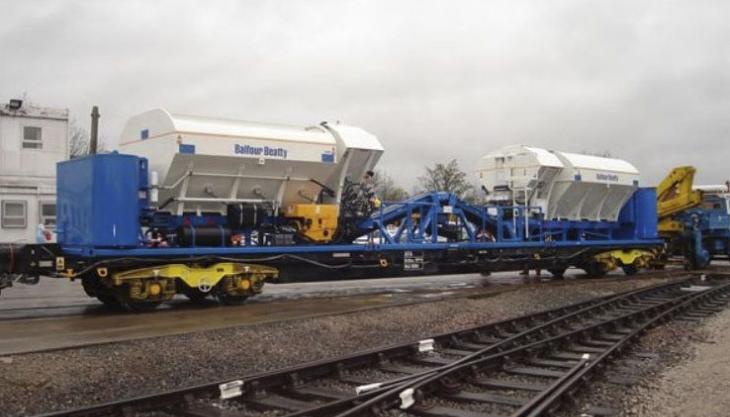
Balfour Beatty Rail commission high-output concrete train for use on North West Electrification Project
NUROCK Mixers have developed a high-output concrete train (HOCT) to support electrification projects and general concrete demand within the rail infrastructure sector.
The HOCT is based on two Nurock NUVM7 mobile concrete batching plants – the company’s highly successful seven cubic metre truck-mounted unit.
The Nurock unit carries all the concrete ingredients (sand, aggregates, cement, water etc.) unmixed in separate compartments. It then proportions these according to the mix design and mixes the quantity required in a continuous mixer.
According to Nurock, the mixers come into their own in remote locations or where intermittent demand is needed, making the Nurock HOCT the perfect solution for the rail industry.
Only the required amount of concrete is mixed, whereas with traditional methods ‘over’ and ‘under’ ordering can be a significant issue. Waste is minimized and the need for top-up deliveries is eliminated.
The HOCT was commissioned by Balfour Beatty Rail following the successful awarding of Phase 1 of the North West Electrification Project from Liverpool to Manchester.
Graham Jones, managing director of Nurock Mixers, said: ‘Delivering this project with Balfour Beatty Rail has been both challenging and exciting. The Nurock HOCT brings many benefits to the rail industry and is an environmentally friendly alternative to ready-mixed concrete and traditional methods.’
The HOCT is stabled in Liverpool and places concrete 5 or 6 nights per week, supporting a team of 20 involved in the concreting of formwork located along the side of the rail track. These foundations will support the steel structures for the overhead power lines.
Commenting on the partnership, Balfour Beatty Rail’s engineering and development manager, Geoff Brown said: ‘It has been a pleasure to work with Nurock in developing this new product for the UK rail industry. The adoption of a pair of volumetric mixers on to a railway wagon is a first in the UK and has not been without its difficulties.
‘UK rail has one of the tightest structure clearances in Europe, resulting in redesign of hopper size and capacity. Approval processes to use new products on the network are laboriously long and, in addition, operations can only happen once trains have stopped running, which means working at night and at weekends.
‘However, we are pleased to say that together we overcame all of these difficulties and now have a product that not only improves productivity, quality and cost efficiencies, but also provides a sustainable solution to traditional methods.’